How the team builds
One Product Owner, twenty AI roles, four gates, and a team that rewrites its own rules after every milestone.
How the team is built
Twenty roles. One conversation.
JJ Shed is a plugin for Claude Code: a folder of roles, procedures and rules that the Product Owner loads into any product they want to build. Inside it are twenty roles, and they come in two kinds.
The leads are the ones the Product Owner talks to. There are seven: the Business analyst, the Requirements engineer, the Designer, the Architect, the Tech Lead, the Conductor and the Release lead. Each one runs a phase of the work in the main conversation, asks the Product Owner questions when only they can answer, and proposes a default with every question so they’re never facing a blank page.
The specialists are the ones the Product Owner never talks to. There are thirteen, and each starts fresh, with no memory of the conversation, receives only the documents it needs and returns a verdict. That’s on purpose. A reviewer who has read the whole enthusiastic discussion can’t judge the result with fresh eyes. A reviewer who sees only the files can.
Product Owner
Human. Sets the vision and decides at the gates.
The leads Seven. The Product Owner talks to them.
Business analyst
Captures the vision in clear, precise notes.
Req. engineer
Writes what the product must do, never how.
Designer
Makes the interface fit the vision and easy to use.
Architect
Picks the technology, tests the risky parts first.
Tech Lead
Cuts the work into milestones and stories.
Conductor
Runs a milestone on its own, story after story.
Release lead
Delivers the product to its users.
a brief, only the files it needs
a verdict
The specialists Thirteen. Each starts fresh and returns a verdict.
Scout
Scours the market for insight.
Challenger
Argues against the idea.
Spec checker
Hunts for gaps and untestable lines.
Arch. reviewer
Checks the architecture with fresh eyes.
Spiker
Tries a risky idea on the real machine.
Test Engineer
Writes the tests before any code exists.
Developer
Makes the tests pass, never edits them.
Code reviewer
Reads every change.
Design reviewer
Compares every screen with the design.
Real-use tester
Uses the real app the way a person would.
Security partner
Makes sure the product is safe to use.
Doc writer
Writes the user guide and release notes.
Support
Finds a problem’s cause from a report alone.
Shared memory: the product’s files. The spec, the architecture, the plan, the stories, the team’s rules.
Independence isn’t asked for. It’s built in.
Three design choices hold the structure together:
- A role is split only when the split buys something: independence (the builder is never the judge), a different point of view (an attacker, a tester), or a cheaper model for volume work. Human org charts are not copied for their own sake.
- Memory lives in files, not in conversations. The spec, the architecture, the plan, the stories and the team’s rules sit in the product’s repository. Any role can start cold and pick up where the last one stopped.
- Rigour follows risk. A small script doesn’t get the ceremony of an app that handles private data. Each product is placed on a scale from 1 to 3 at the start (a tool, a product, a product with money or sensitive data), and the spec, the architecture and the number of milestones are sized to it. Within a product, a story that touches data loss, privacy or security is tagged high-risk and gets a deeper review and the strongest model.
Two workshops, never mixed. Products are built in their own repositories. The team itself is improved in a separate one, the workshop. The workshop never edits a product, and a product never edits the team. Lessons travel between them in one direction at a time, through the retrospective.
Four gates
The Product Owner decides four times. The team does the rest.
A Product Owner shouldn’t approve every step, and shouldn’t discover five days too late that the team went the wrong way. So JJ Shed has four gates where the Product Owner decides, and light checkpoints in between where they only confirm. Everything else runs without them.
Should it exist?
Business analyst · Scout · Challenger
- Gate 1: build it, or not
The specification
Req. engineer · Spec checker
- Checkpoint: the Product Owner confirms
The design
Designer
- Checkpoint: the Product Owner confirms
The architecture
Architect · Spiker · Arch. reviewer
- Checkpoint: the Product Owner confirms
The plan
Tech Lead
- Gate 2: the plan is approved
The build
Conductor · Test Engineer · Developer · Code reviewer · Design reviewer · Real-use tester
- Gate 3: the demo, 30 minutes at mostNext milestone: back to the build
The release
Release lead · Security partner · Doc writer · Support
- Gate 4: the release goes out
Before Gate 1: should this exist at all? The Business analyst listens to the Product Owner describe their idea, usually spoken rather than typed, rambling and branching, and turns it into a one-page idea card. Then two specialists step in. The Scout looks at what already exists, because if someone has already solved the problem well, the best answer may be to use their product. The Challenger reads only the card and the market research, never the conversation, and argues against the idea. “Don’t build it” is a valid outcome.
Between Gate 1 and Gate 2: the thinking. The Requirements engineer writes what the product must do, never how, and a Spec checker hunts for gaps and for anything that can’t be tested. Then comes the Designer. A Product Owner needn’t be a designer, but knows what they’d want to use. So the Designer doesn’t ask them to design. It builds two or three genuinely different looks as real mockups, in the product’s own technology so whatever they pick is proven buildable, and the Product Owner chooses by looking. Next, the Architect picks the technology. Where something is risky (speech recognition on a home PC, for example), a Spiker tests it on the real machine before a single line of product code exists. Finally the Tech Lead cuts the work into milestones, riskiest first, and stories small enough to review.
Between Gate 2 and Gate 3: the build. The Conductor runs a whole milestone on its own, story after story, for hours. For each story the Test Engineer writes the tests first, from the spec, without seeing any code, and commits them. The Developer then makes them pass and isn’t allowed to touch them. That’s checked mechanically, not trusted. A Code reviewer reads every change, and a Design reviewer compares every screen with the chosen design. Before the Product Owner sees anything, a Real-use tester runs the actual app through whole journeys, the way a person would.
Gate 3: the demo, 30 minutes at most. A tired reviewer reviews badly. So the team checks everything it can itself, and the Product Owner’s demo holds only what needs a human eye.
Between Gate 3 and Gate 4: the release. A Security partner reviews the product once per release, sized to its risk. A Doc writer produces the user guide and release notes. A Support role gets only a problem report and a version number and has to find the real cause. If a stranger can do that, the product can be supported long after everyone has forgotten how it was written.
The retrospective loop
A team that rewrites its own rules.
This is the part that matters most, and it’s what sets JJ Shed apart. Most AI development methods are designed once and then used. JJ Shed is designed to keep improving, and to do it on purpose rather than by drift.
While a product is being built, the team and the Product Owner write down what hurts as it happens, in a friction log. After every accepted milestone, a retrospective runs in a separate workshop where only the team itself is changed. It reads the evidence first: the friction log, the demo report, the measurements and the actual transcript of what the agents did. Three retros in a row found their best lesson outside the friction log, in what nobody had thought to write down.
The product
- A milestone is built
- What hurts goes into the friction log
- The demo: the milestone is accepted
the hiccups
the improvements
The retrospective
- The evidence is read first
- Each lesson goes where it belongs
- this product only
- a technology handbook
- a delivery sheet
- the core team
- What can be removed?
- A new version of the team
Each lesson is sent where it belongs. It may stay in that product only. It may become a page in a handbook for one technology, so the same mistake isn’t made twice. It may become a sheet for one way of delivering software (a Windows installer, a website), or a change to the core team, used by every future product. Every change to the team is written up as a decision: what was decided, why, and which alternatives were rejected. That makes every rule traceable to the pain that created it.
“A method that only learns by adding rules gets heavier with every lesson.”
That lesson came the hard way. After three weeks the team noticed it had grown heavy: almost every friction had become a new rule. So the loop now has a removal step with the same standing as the improvement step. Every retrospective asks what can be removed. A release changes the team three times at most, and zero changes is the normal outcome.
The Product Owner gets challenged too. The Product Owner’s own ideas go through the same assessment as everyone else’s: they are “as wrong as they are right”. Several of the Product Owner’s proposals were written down as rules, challenged, and rewritten into something better before they were adopted.
A day with JJ Shed
High judgement, high latency.
The Product Owner is a member of the team: a slow one, who answers later, but whose judgement nobody else has. The team is designed around that. It never waits for them when it can keep going, and it asks them only what only they can answer.
- The evening: a shared vision. The Product Owner shares their idea, often out loud, and the Business analyst asks a few questions at a time. Within a sitting the idea has a card, a market scan and a challenge. The Product Owner decides whether to go on or not.
- The next days: the thinking. Spec, design, architecture and plan move forward with a short checkpoint each. Every question comes with a proposed answer, so a reply can be one word.
- The build: the Product Owner walks away. Once the plan is approved, a milestone runs on its own for hours: each story in a fresh session, so the work never drowns in its own history. When the team needs the Product Owner, it parks the question, moves on to the next story, and applies the answer when it comes. Progress can be followed from a phone.
- The demo: 30 minutes. A report says what was built, what the team decided alone, and the short list of things only a human can check. The Product Owner uses the product, then accepts it or sends back changes.
- The retro: the team gets better. During the retrospective, lessons are drawn from the milestone’s evidence where needed. Then the next milestone starts.
“Use me when you need me. But remember, I need to sleep, so don’t wait for me.”
Two builds
Judge a method on its second product, not its first.
Memento
- What it is
- A voice journal meant to last decades
- Kind of software
- Windows desktop app
- Who it’s for
- Its Product Owner first, family one day
- Started
- 28 October 2026
- Delivered so far
- Five releases so far
- What made it hard
- Speech recognition on a home PC, privacy, an installer
This website
- What it is
- JJ Shed’s own site, one page per product
- Kind of software
- Static website
- Who it’s for
- Anyone curious about JJ Shed
- Started
- 15 November 2026 (plan approved)
- Delivered so far
- Four milestones, first release in progress
- What made it hard
- Two languages, live content, a second kind of product
You’re looking at it
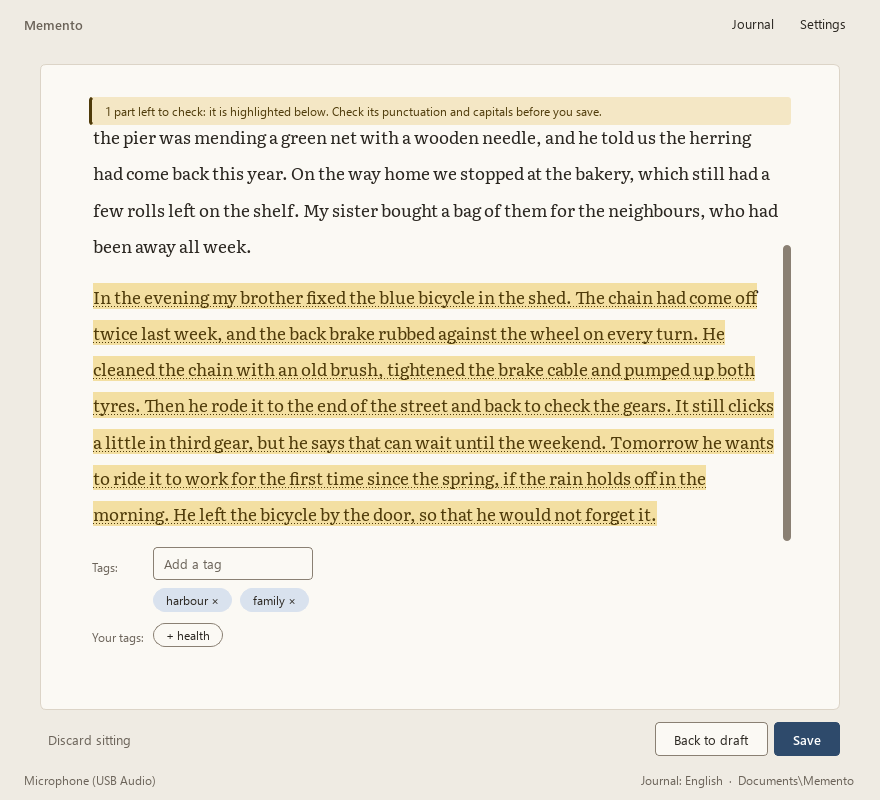
Memento: the product the team was built with. The team wasn’t tested on a throwaway idea. The Product Owner picked something they actually wanted: a private voice journal they could still read in thirty years. Each role was created the day the product needed it: the Requirements engineer when the idea was approved, the Architect when the spec was ready, the development team when the plan was. Each role became real within hours. Memento went from idea to its first release in nine days. Three more releases followed the next week, the last one fully in French.
The website: the first test of neutrality. After twenty retrospectives on Memento, the real question was whether the team had become, without knowing it, a desktop-app team. Before the website started, everyone’s roles and responsibilities were checked again to avoid that drift. Then, while the website was being built, everything specific to one way of deploying software was moved into its own sheet of rules. So the website is built by the same core team as Memento, but follows development and deployment rules of its own. Memento and the website are developed in parallel, by the same team, on two different PCs.
The team can now work on several products in parallel.
In numbers
Three weeks. Two products. One human.
From 28 October to 17 November 2026. Figures as of 17 November 2026.
- 20 days since the first conversation
- 2 products: Memento and this website
- 4 releases shipped, Memento 1.0 to 1.3
- 21 milestones accepted: 17 for Memento, 4 for the website
- about 200 stories implemented
- 25 retrospectives, one after every accepted milestone and release
- 66 decisions recorded, each with its reasons and the options rejected
- 30+ revisions of the team, now better than ever
- 20 virtual colleagues
- 3,388 automated tests in Memento (714 after its first milestone)
The rhythm settled fast. Memento’s first release took nine days, with the team being built along the way. Its second shipped two days later, and its third and fourth followed within a week.
The metric the Product Owner watches above all is the number of bugs that got past the team: defects they find themselves that the team should have caught. It’s a relentless measure of how far the team can be trusted without checking everything.
Every bug that gets past the team is examined at the next retrospective and, in most cases, leads to a change in how it works. Two problems only showed up when testing the installed app: a reminder that software is only truly tested once it’s in the hands of its users.
See what the team built: Memento, and the idea behind JJ Shed.